Back to Basics

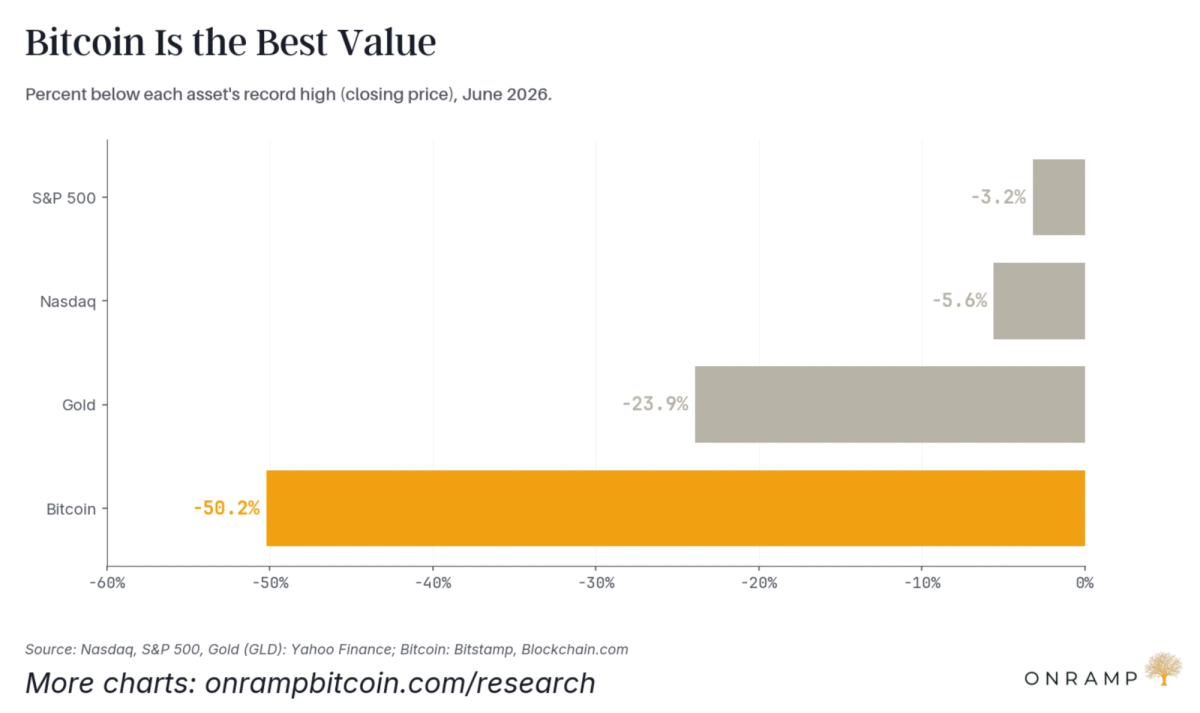
Bitcoin trades today at about half of its late-2025 high, even as equities and gold stand at or near records of their own. For a different asset, that divergence might signal trouble. For bitcoin, whose supply is fixed and whose adoption remains at a relatively early stage, it has more often marked an opportunity than a warning. Periods like this one are a useful time to return to first principles, and that is what this report does, in three parts.
The basics
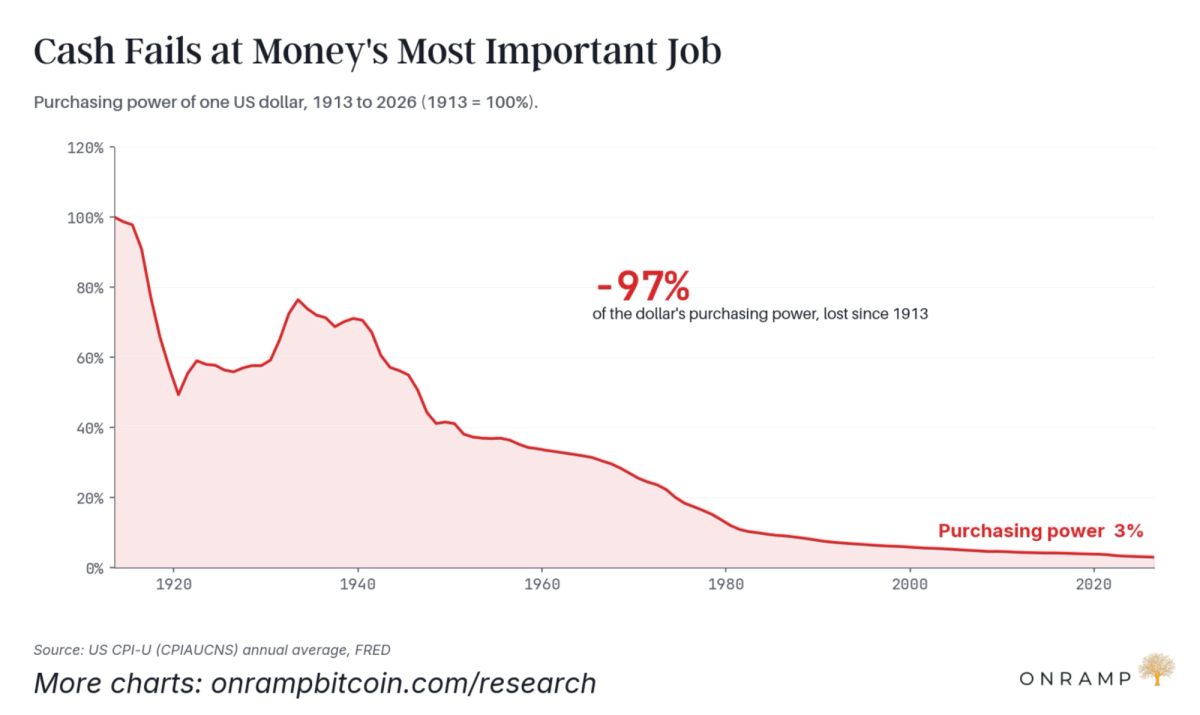
The first part reviews ten ideas that underpin the case for owning bitcoin. Money's most important job is storing value over time, and the cash most people hold has failed at it, losing 97% of its purchasing power since 1913 by design rather than mismanagement. Bitcoin answers that failure with a scarcity that can be verified rather than merely trusted: a hard cap of 21 million coins, roughly 95.4% of them already issued, enforced by a distributed network that no single party can alter.
The report walks through how the fixed issuance schedule works, why decentralization makes the rules credible, how proof of work converts energy into security, and why bitcoin extends gold's monetary role into a form suited to a digital economy. It closes with the two ideas that frame everything that follows: owning bitcoin is different from owning a claim on it, and real ownership means holding it in cold storage under keys you control.
Paper bitcoin
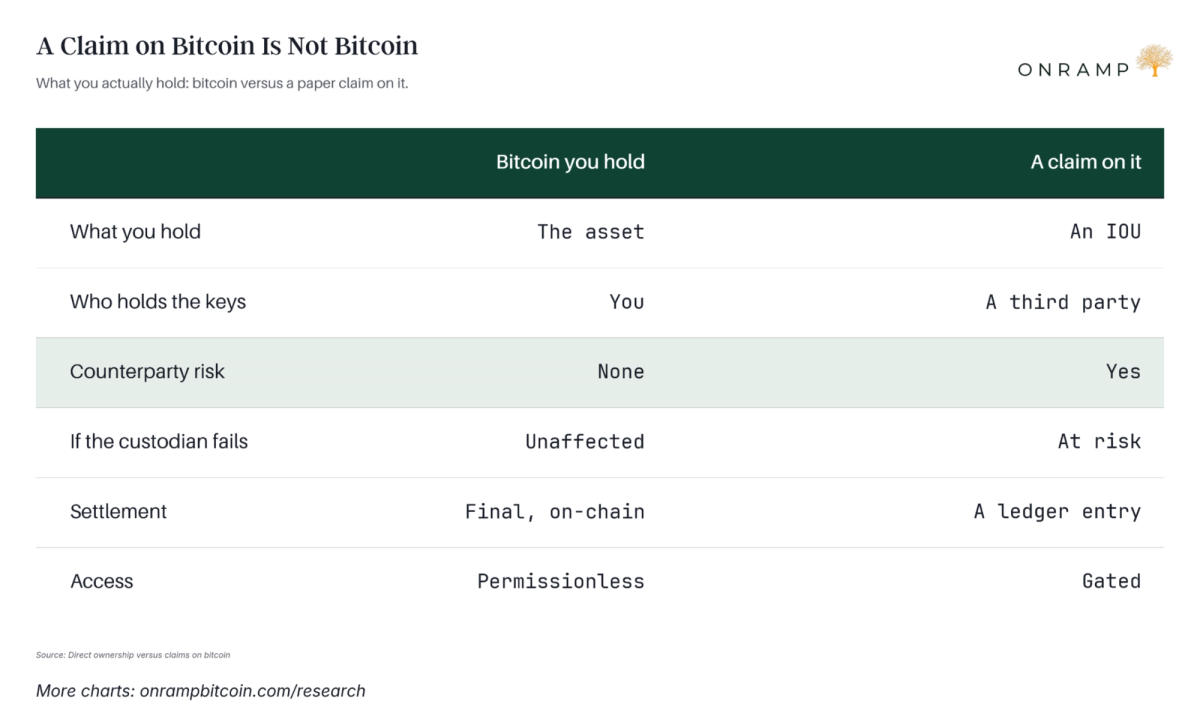
The second part examines what is lost when bitcoin is held through a wrapper. A fund share, an exchange balance, or a structured credit product can track the price closely, but each is the liability of an issuer, and the holder is returned to the counterparty network that bitcoin was designed to circumvent. Price exposure is the most easily replicated part of the proposition; the bearer quality, the absence of a counterparty, and the finality of settlement are what give the asset its distinctive value, and they are precisely what the wrapper removes.
The report takes up the two arguments commonly used to justify paper exposure, that custody is too hard and that volatility is too much, and shows why each solves the wrong problem. The recent strain among engineered bitcoin credit products has made the distinction concrete.
The market opportunity
The third part turns to timing. The current drawdown of roughly 50% is the shallowest of bitcoin's major cycles; the four that preceded it ranged from 77% to 93%, and each was followed, in time, by a new all-time high.
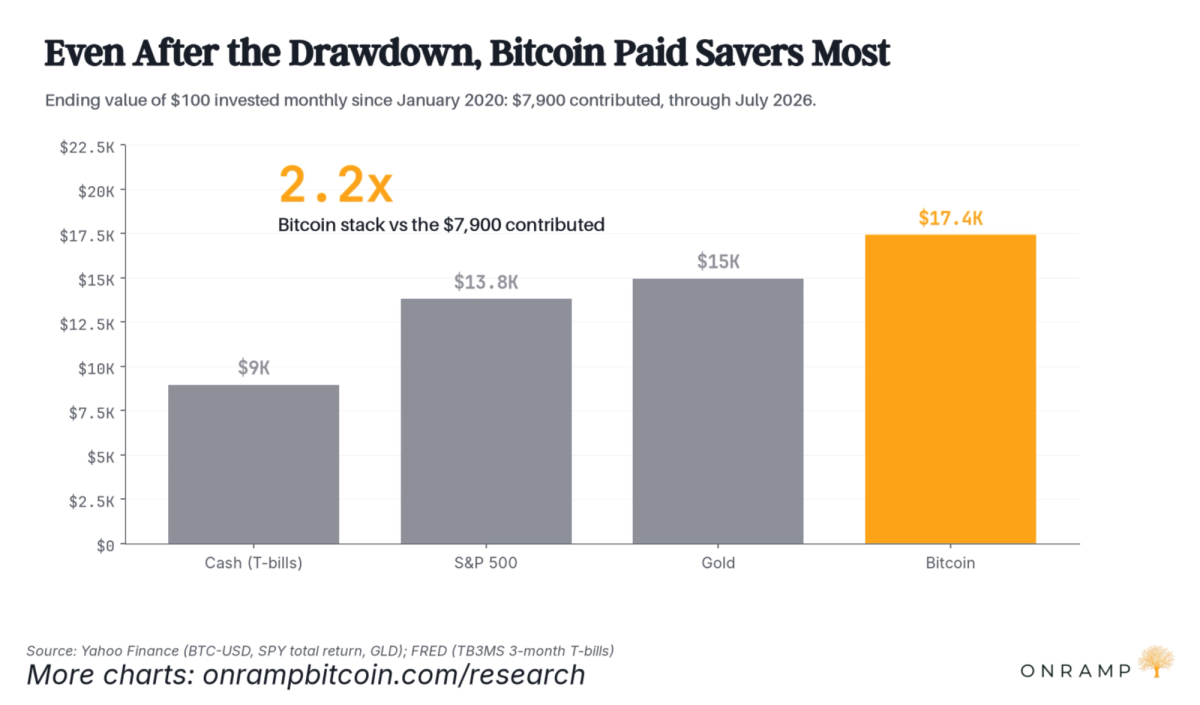
Steady accumulation has held up well even through the decline: $100 invested monthly since January 2020, $7,900 in total, would be worth about $17,400 in bitcoin as of July 2026, ahead of the same schedule applied to gold, the S&P 500, or Treasury bills. And the context matters. Equities sit within a few percent of their records and gold near its own peak, while bitcoin is among the few major assets available at a meaningful discount. A lower price on an asset of fixed supply and expanding adoption is, if anything, the thesis operating in the investor's favor.
The full report sets out the data behind each of these conclusions, chart by chart.
Get back to basics with Onramp
The approach the report recommends requires no forecasting: buy on a regular schedule while prices are low, and hold what you accumulate in custody you genuinely control.
This summer, Onramp is making that easier to act on, with 50% off trading fees through September 7 and recurring buys at no cost, alongside Multi-Institution Custody that distributes keys across independent institutions so no single party can move your bitcoin and no single failure can lose it.