Bitcoin as a Strategic Asset for Family Offices

Family offices are increasingly allocating to Bitcoin as a strategic reserve asset that preserves purchasing power over generations. Bitcoin's fixed supply and institutional custody infrastructure make it ideal for long-term family office portfolios. Onramp holds $1B+ in Bitcoin under Multi-Institution Custody. Each vault is protected by three independent institutions.
The Full Report
The full text of Bitcoin as a Strategic Asset for Family Offices, first published by Onramp Research on September 23, 2025.
Introduction: The Evolving Role of Family Offices in Wealth Management
Family offices are stewards of dynastic wealth. Their charge is simple in theory but daunting in practice: grow wealth, preserve purchasing power, and ensure legacies endure across generations. Unlike fund managers chasing quarterly alpha, they operate with a far longer horizon, one that demands capital be aligned not only with investment returns, but with the family’s values.
This mandate stretches well beyond portfolio construction. It requires prudence, risk control, and stewardship, qualities that insulate families from shocks, whether market-driven or political.
Yet the ground beneath traditional assets is shifting. Bonds, once the ballast of conservative portfolios, now swing with volatility not seen in decades, often moving in lockstep with equities. Stocks themselves are increasingly hostage to central bank monetary policy. Even real estate, long considered the most tangible anchor of wealth, faces liquidity and valuation risks.
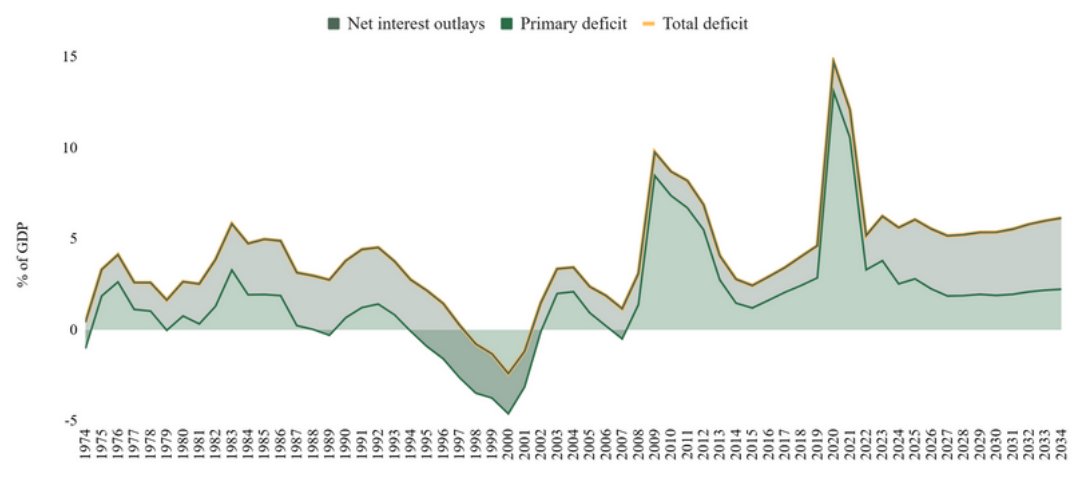
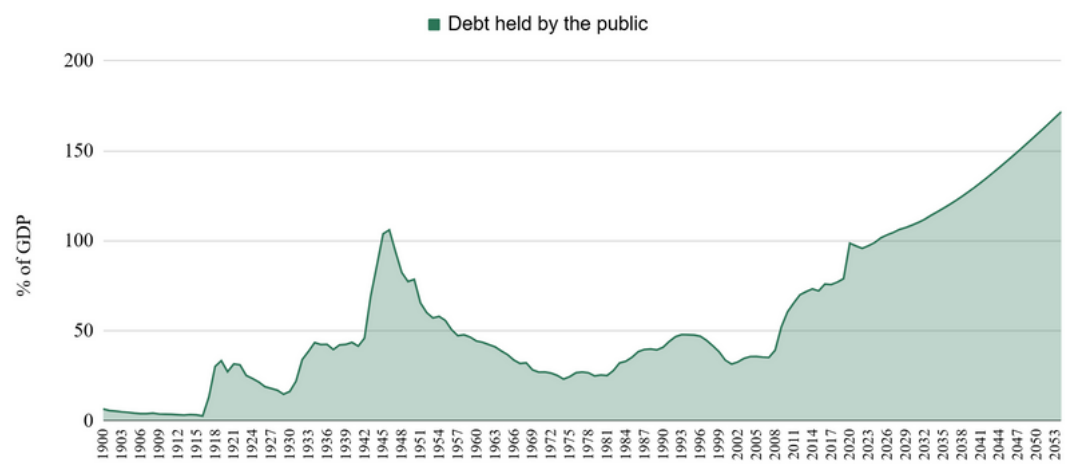
The warning signs are visible on the sovereign balance sheet. Federal spending has outrun revenues for half a century (Figure 1 below). Deficits are no longer an anomaly, they are policy. Interest costs alone consume a rising share of output (Figure 2 below), while debt-to-GDP has surged to levels once reserved for world wars (Figure 3 below). Families that once trusted government paper as a safe haven now see the issuer itself dependent on monetization of its debt instruments.
For family offices, the implication is stark: the traditional toolkit is losing its ability to safeguard wealth. The search is on for assets that are resilient, inflation-resistant, and uncorrelated.
This is why Bitcoin is becoming an asset class. With its decentralized architecture, fixed supply, and immunity to currency debasement, it offers a hedge enforced by mathematics. Thoughtfully integrated, Bitcoin is not a speculative bet: it is a tool to reinforce the timeless objectives of wealth preservation, growth, and values-driven investment.

Core Investment Objectives of Family Offices
Family offices invest with a mandate far broader than annual returns. Their task is to protect purchasing power, grow capital prudently, and ensure that wealth reflects the values of the family it represents. These objectives form the lens through which every asset, including Bitcoin, must be judged.
Wealth Preservation: Protecting Purchasing Power
The foundation is simple: ensure tomorrow’s wealth buys at least as much as today’s. Inflation, currency debasement, and policy-driven market shocks erode that foundation. Family offices seek assets with a track record of holding real value when others falter, because without preservation, nothing else endures.
Growth: Expanding Capital Across Time
Preservation alone is not enough. Families must also grow their capital to support future generations. With long time horizons, family offices can look beyond liquid markets into private equity, venture capital, and increasingly, digital assets like Bitcoin, pursuing growth without succumbing to short-term volatility.
Values and Legacy: Wealth as a Reflection of Identity
For many families, money is a mirror of their values. Investments are chosen not only for returns but for alignment with principles: philanthropy, sustainability, community impact. By embedding values into investment allocation decisions, family offices ensure that wealth serves a purpose greater than itself: reinforcing the legacy that endures long after capital is spent.
Investment Philosophy: Family-Centric, Long-Term Focus
Family offices operate with a distinctive philosophy: protecting and growing wealth across generations. Unlike institutional asset managers driven by quarterly performance for marketing reasons, they focus on sustainability, resilience, and legacy. This perspective demands patient capital, disciplined risk management, and investments that reflect both financial objectives and family values.
Playing the Long Game
Family offices measure success not in years, but in decades. Their advantage lies in the ability to hold assets through cycles, letting compounding work across generations. This patience supports exposure to illiquid and volatile opportunities (private equity, real estate, and increasingly, Bitcoin) that can deliver substantial long-term returns.
The impact of this horizon is visible in simple math. A $100,000 allocation held across asset classes compounds very differently over twenty years (Figure 5 below). For families, the discipline of staying invested often matters more than timing, making long-term positioning the foundation of wealth sustainability.
Freedom to Move Where Institutions Can’t
Unburdened by heavy regulation, family offices enjoy flexibility that large institutions lack. They can act quickly, pursue niche opportunities, and tailor allocations to unique family goals. This agility is a strategic advantage in today’s fluid markets, particularly when considering emerging alternatives like Bitcoin, which fall outside most traditional institutional mandates.
True Diversification, Not Just Variation
Diversification is more than allocation across equities and bonds; it’s about reducing exposure to the same risks that threaten both. Bitcoin’s independence from currency debasement and its low correlation to traditional assets make it a distinct hedge against inflation and policy-driven volatility. For families, such an uncorrelated assets alongside stable, income-generating holdings builds resilience while positioning the portfolio for growth.
| Asset Class | Expected 20Y CAGR (%) | Volatility | Approx Standard Deviation (%) | Skewness |
|---|---|---|---|---|
| Bitcoin | 20.00% | High | ~50 | Positive |
| Private Equity | 12.00% | Moderate | ~20 | Positive |
| Equities | 7.5% | Moderate | ~15 | Slightly Positive |
| Bonds | 4.50% | Low | ~5 | Near Zero |
| Gold | 6.0% | Low | ~10 | Slightly Positive |
Assumptions: 20-year horizon; vol/SD indicative; skewness qualitative.
A $100,000 investment over 20 years highlights the asymmetric growth potential of Bitcoin compared with traditional asset classes. While private equity, equities, bonds, and gold show modest compounding, Bitcoin demonstrates exponential upside driven by its fixed supply and increasing global adoption.
| Year | Bitcoin (USD $) | Private Equity | Equities | Bonds | Gold |
|---|---|---|---|---|---|
| 0 | 100,000 | 100,000 | 100,000 | 100,000 | 100,000 |
| 1 | 120,000 | 112,000 | 107,500 | 104,500 | 106,000 |
| 2 | 144,000 | 125,440 | 115,563 | 109,203 | 112,360 |
| 3 | 172,800 | 140,493 | 124,230 | 114,117 | 119,102 |
| 4 | 207,360 | 157,352 | 133,547 | 119,252 | 126,248 |
| 5 | 248,832 | 176,234 | 143,563 | 124,618 | 133,823 |
| 6 | 298,598 | 197,382 | 154,330 | 130,226 | 141,852 |
| 7 | 358,318 | 221,068 | 165,905 | 136,086 | 150,363 |
| 8 | 429,982 | 247,596 | 178,348 | 142,210 | 159,385 |
| 9 | 515,978 | 277,308 | 191,724 | 148,610 | 168,948 |
| 10 | 619,174 | 310,585 | 206,103 | 155,297 | 179,085 |
| 11 | 743,008 | 347,855 | 221,561 | 162,285 | 189,830 |
| 12 | 891,610 | 389,598 | 238,178 | 169,588 | 201,220 |
| 13 | 1,069,932 | 436,349 | 256,041 | 177,220 | 213,293 |
| 14 | 1,283,918 | 488,711 | 275,244 | 185,194 | 226,090 |
| 15 | 1,540,702 | 547,357 | 295,888 | 193,528 | 239,656 |
| 16 | 1,848,843 | 613,039 | 318,079 | 202,237 | 254,035 |
| 17 | 2,218,611 | 686,604 | 341,935 | 211,338 | 269,277 |
| 18 | 2,662,333 | 768,997 | 367,580 | 220,848 | 285,434 |
| 19 | 3,194,800 | 861,276 | 395,149 | 230,786 | 302,560 |
Assumptions: Initial $100,000; annual compounding at stated rates; no fees or taxes; values rounded to the nearest $1.
Traditional Family Office Investment Strategies and Limitations
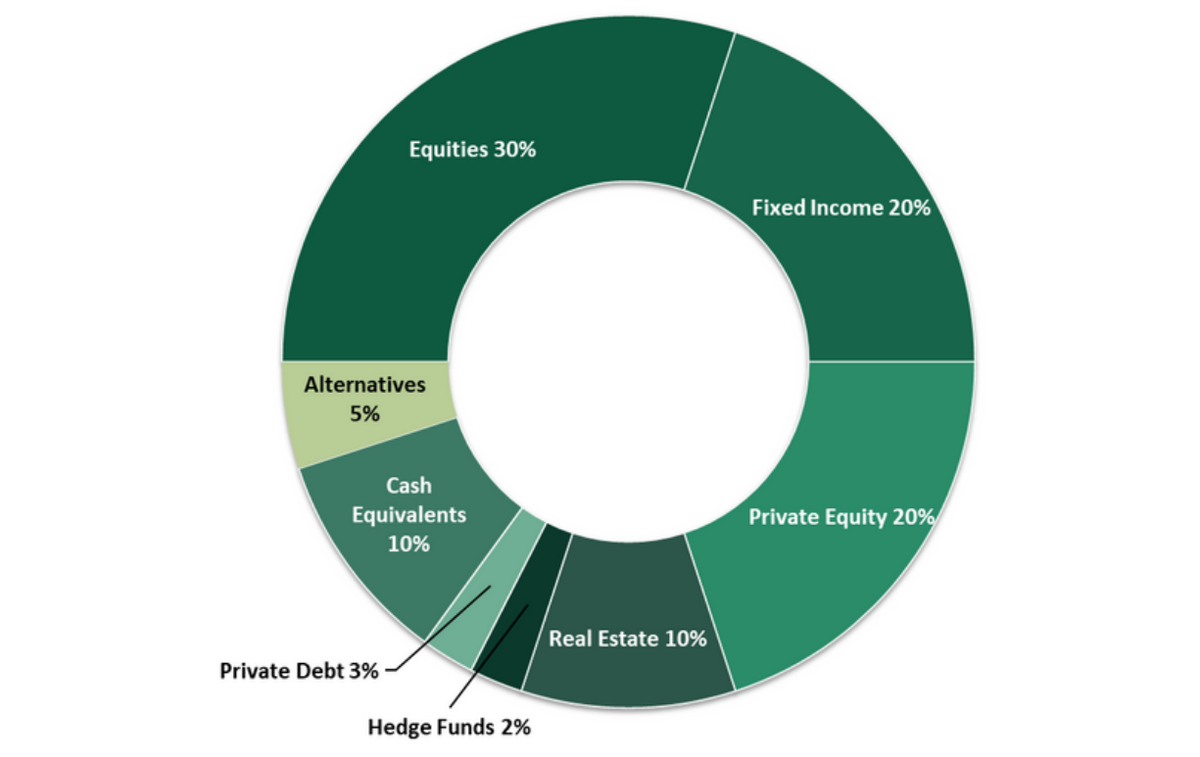
Family offices have long relied on diversified portfolios designed to preserve wealth across generations while enabling steady growth. Unlike quarterly-driven institutional investors, their approach is typically patient and values-driven, reflecting each family’s unique goals and risk tolerances. Core allocations span equities, fixed income, private equity, real estate, hedge funds, and alternatives, each chosen to balance resilience with opportunity.
Portfolio Construction and Core Allocations
Most family office portfolios follow a familiar mix of traditional and alternative assets, broadly resembling the allocation below. Each asset plays a distinct role:
- Equities (≈30%): Growth driver, split between developed and emerging markets. Provides liquidity and appreciation but exposes families to correlated volatility.
- Fixed Income (≈20%): Historically the conservative anchor, now challenged by inflation’s erosion of real returns and higher correlation with equities.
- Private Equity (≈20%): Favoured for long-term outperformance and influence, but hampered by illiquidity and lock-ups.
- Real Estate (≈10%): Tangible, income-generating, and inflation-protective, though recent demand shifts have increased unpredictability.
- Hedge Funds & Private Debt (≈5–7.5%): Tools for diversification and stable yields, but often costly and complex.
- Cash & Equivalents (≈10%): Maintains flexibility, though in inflationary regimes it steadily loses real value.
- Other Alternatives (≈2.5–5%): Infrastructure, commodities, art, and metals, niche diversifiers with higher costs and lower liquidity.
Structural Weaknesses in the Traditional Model
While these allocations serve preservation, liquidity, and growth, they are increasingly tested by today’s environment:
- Inflation Erosion: Cash and bonds rarely keep pace, undermining wealth preservation. Even real estate’s hedge role has become less reliable.
- Liquidity Traps: Heavy exposure to private equity and real estate ties up capital, leaving families exposed to unexpected liquidity risks.
- Correlation Risks: Equities and bonds, once reliable counterweights, now move in closer tandem, weakening diversification.
- Valuation Pressure: Elevated prices in equity, private equity, credit and real estate heighten downside risk if cycles turn.
- Deal Competition: Rising capital inflows make it harder to source high-quality, good value opportunities.
The Case for Innovation
These structural challenges explain why family offices are rethinking their allocations. Incremental diversification is no longer enough. To preserve purchasing power, maintain liquidity, and protect against systemic shocks, many are exploring assets outside the traditional playbook.
Bitcoin is increasingly under consideration, not as a speculative bet, but as a strategic allocation. With its low correlation to traditional markets, built-in scarcity, and deepening liquidity, it offers a hedge against inflation, currency risk, and portfolio concentration. Integrated thoughtfully, Bitcoin can complement existing holdings, helping family offices achieve the resilience and adaptability required in a shifting financial landscape.
Traditional assets (equities, bonds, private equity, real estate) dominate most portfolios, each with clear strengths but also structural limitations. Bitcoin, while typically allocated at just 1–5%, offers unique attributes (finite supply, low correlation, and inflation resistance) that directly complement family office objectives of preservation, growth, and values alignment.
| Asset Class | Function in Portfolio | Strengths | Limitations | Size of Allocation (%) |
|---|---|---|---|---|
| Equities | Capital appreciation, global economic growth | High growth potential in specific sectors | Market volatility, reliance on economic growth | 25-30% |
| Fixed Income | Income generation, stability | Stable income, cushions equity volatility | Eroded purchasing power in inflation | 15-20% |
| Private Equity | High long-term returns, illiquidity premium | Illiquidity premium and active involvement | Long lock-up periods, liquidity risks | 15-20% |
| Real Estate | Inflation hedge, income generation | Tangible value, inflation protection | Performance variability, regulatory shifts | 0 |
| Hedge Funds and Private Debt | Diversification, stable yields | Diversification with non-correlated strategies | High fees, complexity, careful due diligence | 5-7.5% |
| Cash and Cash Equivalents | Liquidity for opportunities/emergencies | Highly liquid for tactical needs | Erosion of real value during inflation | 0 |
| Other Alternatives | Diversification, unique return drivers | Non-traditional, diverse risk-return profiles | Limited liquidity, high transaction costs | 2.5-5% |
| Bitcoin | Inflation hedge, diversification, high growth | Finite supply, low correlation, significant upside | Volatility, requires secure custody | 1-5% |
The Strategic Case for Bitcoin in Family Office Portfolios
Family offices are increasingly turning to innovative strategies to navigate today’s twin challenges: preserving wealth against inflation and unlocking meaningful long-term growth. Against this backdrop, Bitcoin stands out as a compelling addition to the family office toolkit. Its defining qualities (a decentralized network, strictly finite supply, and independence from traditional financial systems) position it uniquely to complement existing allocations. Unlike traditional hedges or growth assets, Bitcoin combines scarcity, resilience, and asymmetric upside in ways that align directly with family office priorities.
Inflation Hedge: Preserving Purchasing Power in an Era of Currency Debasement
Safeguarding wealth against inflation is central to intergenerational investing. Traditional hedges like bonds or real estate are proving less effective, with yields eroded by persistent inflation and economic uncertainty. Bitcoin introduces a structural advantage: its supply is permanently capped at 21 million. This finite nature insulates it from the monetary expansion and currency debasement that undermine fiat assets.
Over the past decade, Bitcoin has consistently outpaced both inflation and traditional asset classes during periods of economic stress. Unlike gold or fixed income, its independence from government policy adds a layer of protection against systemic risks. For family offices seeking assets with built-in scarcity and purchasing power preservation, Bitcoin provides a differentiated hedge that traditional instruments increasingly fail to deliver.
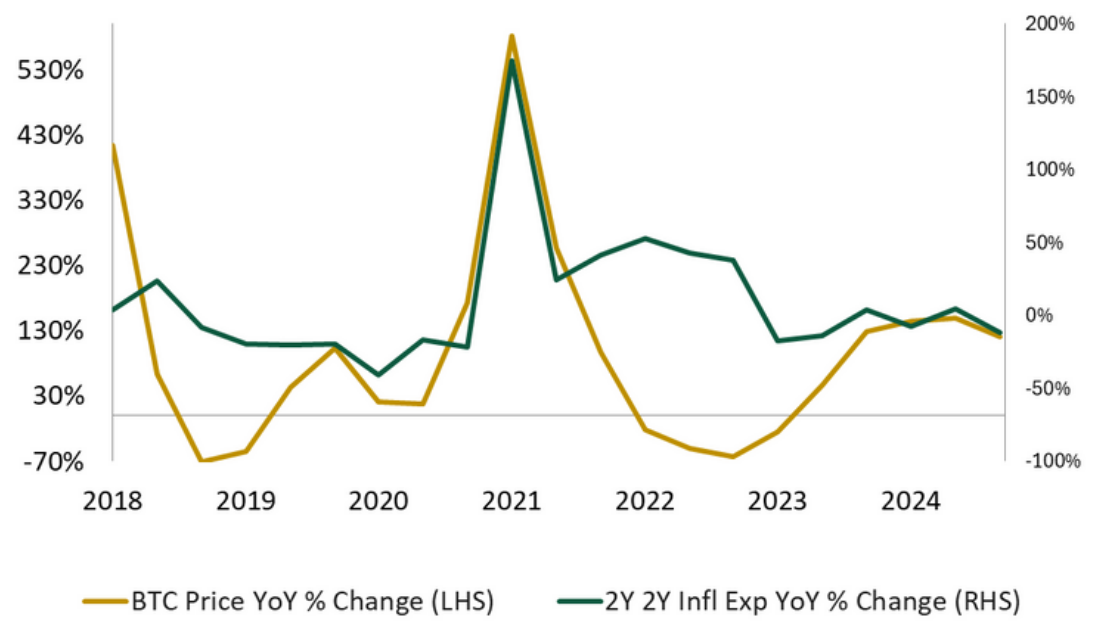
Source: Onramp Bitcoin, Federal Reserve Bank of St Louis, Investing.com
Low-Correlation Asset: Strengthening Diversification in Correlated Markets
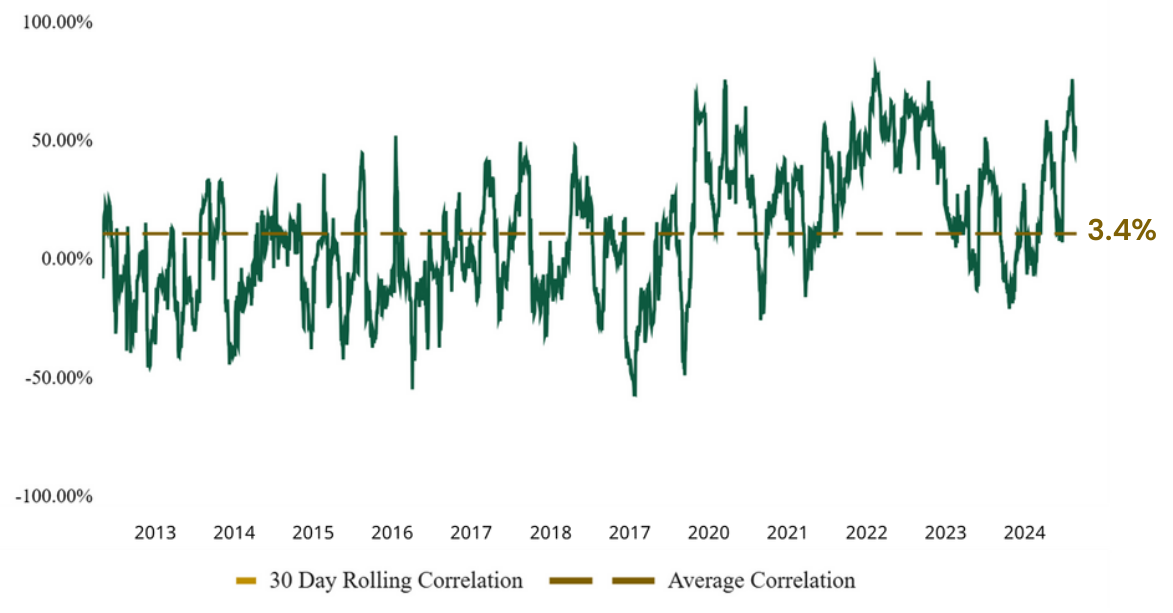
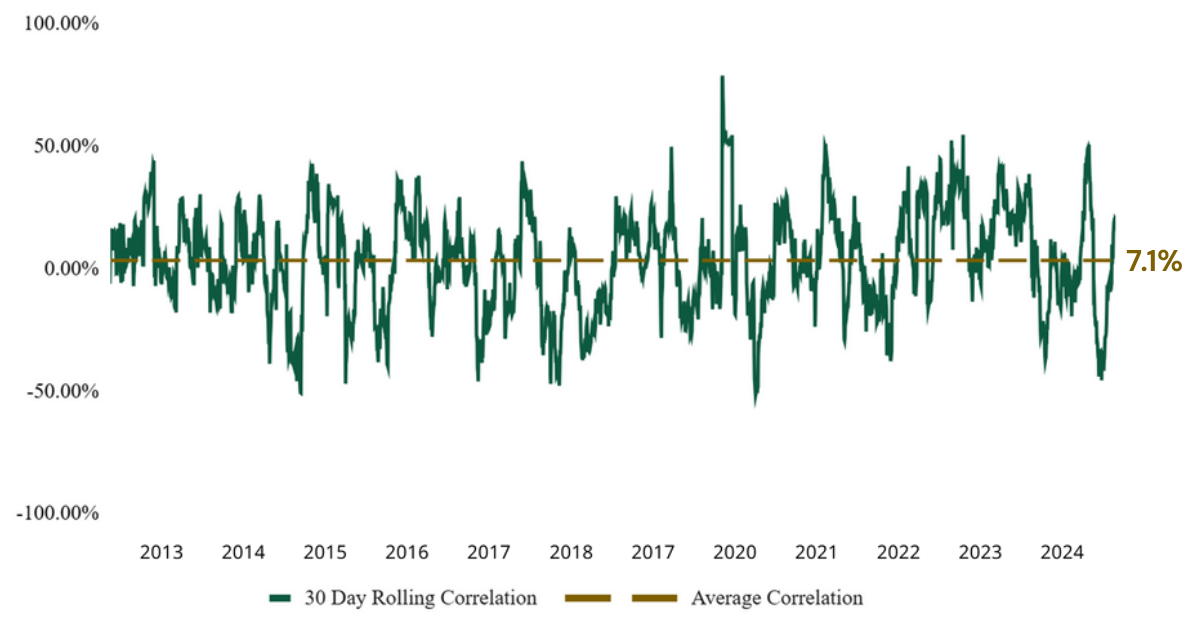
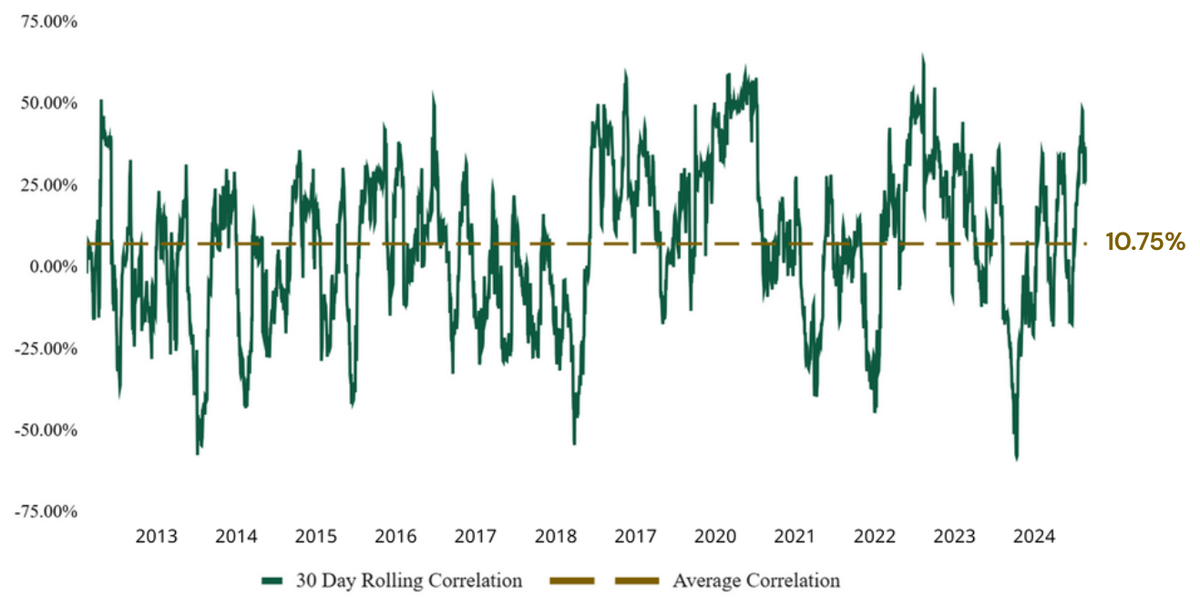
Diversification is a cornerstone of family office portfolios, yet in recent years, correlations among equities, bonds, and real estate have risen sharply. Traditional portfolios, once thought to be well-balanced, now risk moving in tandem during systemic shocks. Bitcoin’s performance profile is different. Its low correlation with mainstream asset classes makes it a valuable tool for improving resilience.
A modest allocation, typically in the 1–5% range, can reduce portfolio vulnerability to market-wide downturns, providing ballast when other assets falter. Because Bitcoin is untethered from corporate earnings cycles or central bank decisions, it behaves independently, enhancing portfolio stability at the margin without requiring significant reallocation.
Growth Potential: Capturing Asymmetric Upside from Global Adoption
Beyond preservation and diversification, family offices must also secure growth that compounds across generations. Bitcoin’s growth trajectory is underpinned by global adoption, technological innovation, and institutional legitimization. With demand expanding while supply remains fixed, Bitcoin offers asymmetric upside unmatched by traditional assets.
For many families, Bitcoin also carries generational relevance. Younger members, digital natives, view it not only as a high-growth opportunity but also as a store of value suited to the digital era. Incorporating Bitcoin into portfolios allows family offices to engage with these next-generation priorities while positioning their portfolio to capture potential outsized returns.
| Time Period | Bitcoin | Gold | S&P 500 |
|---|---|---|---|
| 1 year | 96% | 34% | 16% |
| 2 year | 110% | 33% | 21% |
| 3 year | 74% | 24% | 16% |
| 4 year | 25% | 17% | 10% |
| 5 year | 58% | 12% | 14% |
| 6 year | 48% | 14% | 14% |
| 7 year | 51% | 16% | 12% |
| 8 year | 52% | 13% | 13% |
| 9 year | 80% | 11% | 13% |
| 10 year | 86% | 11% | 13% |
| 11 year | 63% | 9% | 11% |
| 12 year | 79% | 8% | 12% |
| 13 year | 106% | 6% | 12% |
| 14 year | 94% | 4% | 13% |
Efficiency in Action: Doing More with Less
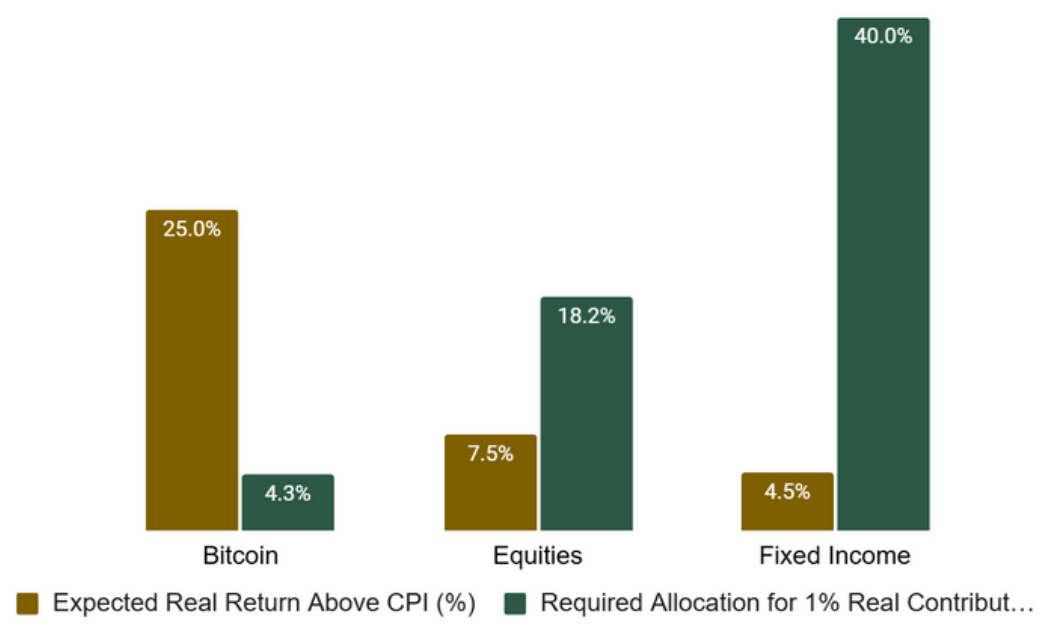
When adjusted for 2% inflation, Bitcoin shows remarkable efficiency versus traditional assets. To deliver a 1% expected real return contribution, it needs only a 4.3% allocation, compared with 18.2% for equities and 40% for fixed income. Even a small allocation can materially boost long-term outcomes, freeing capital for other strategic uses.
Designing a Bitcoin Strategy for Family Offices
For family offices considering Bitcoin as part of their portfolios, a structured approach is critical. The aim is to capture Bitcoin’s potential benefits (hedging against inflation, enhancing diversification, and delivering long-term growth) while addressing the unique challenges of multi-generational wealth management. Key elements of such a strategy include a thoughtful allocation size, a robust custody solution, and a disciplined approach to liquidity and income generation.
Strategic Allocation and Phasing (1–5% of Portfolio)
Given its volatility and distinct risk-return profile, Bitcoin is best suited as a modest allocation within the overall portfolio, typically between 1–5% (although this can be significantly higher depending on annual income drawdown requirements. This allows family offices to benefit from its potential upside while avoiding excessive concentration risk.
Phased allocation is often advisable. Family offices may introduce Bitcoin gradually, using approaches such as dollar-cost averaging to mitigate the impact of market fluctuations. This method also accommodates varying comfort levels within the family, particularly as the broader digital asset market continues to mature. Regular reviews and adjustments ensure the allocation remains aligned with long-term objectives.
Custody and Security: Multi-Institutional Solutions
Custody is a central consideration in Bitcoin strategy design. Unlike traditional assets, Bitcoin requires specialized security measures to protect against cyber risks, theft, or loss. Multi-signature wallets, and institutional-grade custodians are all common solutions.
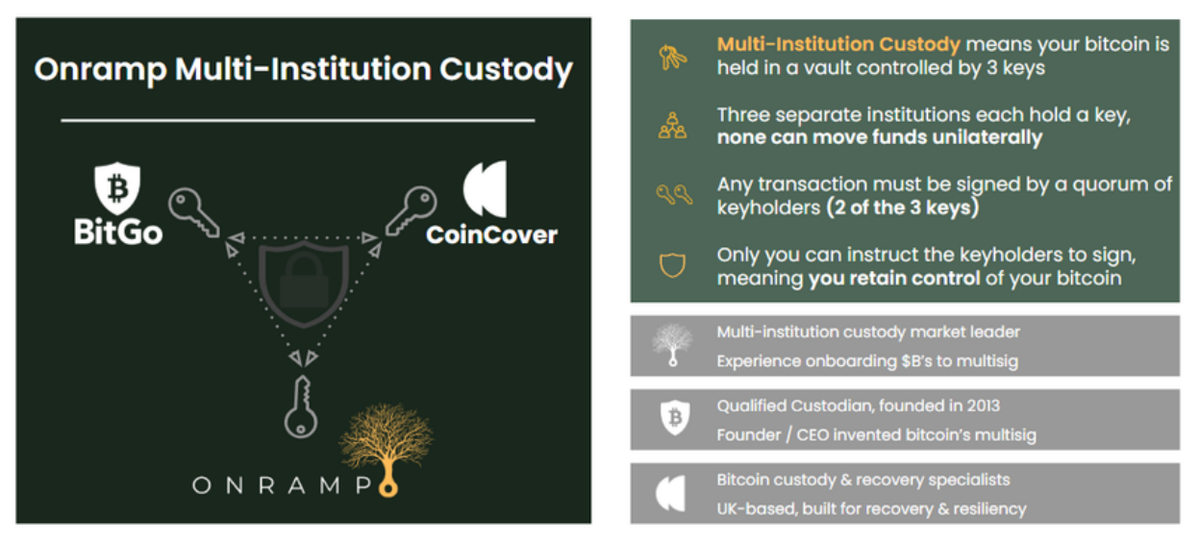
Multi-institutional custody (MIC) is emerging as a best practice for family offices. Under this model, control of Bitcoin is distributed across multiple qualified custodians, often in different jurisdictions. This structure reduces single points of failure, strengthens resilience against regulatory or legal challenges, and provides protections not achievable with traditional assets. It also introduces layers of compliance, such as SOC 2 standard.
Selecting a reliable custody provider is essential, as this decision directly impacts both the security and accessibility of the Bitcoin holdings. Family offices may explore custodians with a strong reputation in the digital asset space, choosing options that offer cold storage, insurance, and compliance with regulatory standards. Additionally, multi-institutional custody, where control of the Bitcoin is distributed among several institutions, can enhance security by reducing single points of failure. By implementing robust custody and security protocols, family offices can manage the risks unique to holding Bitcoin over the long term.
Key Benefits of Multi-Institutional Custody
- Decentralized Custodial Risk: Distributes access keys among multiple custodians, ensuring that no single failure can compromise holdings.
- Multi-Jurisdictional Protection: Provides legal resilience by operating across diverse regulatory regimes.
- Qualified Custodian Oversight: Ensures adherence to stringent security and compliance standards.
- Enhanced Security via Multi-Signature Technology: Requires multiple parties to authorize transactions, preventing unilateral asset movement.
These advantages directly address vulnerabilities in single-custodian models, where insolvency or legal disputes could expose client assets.
Income and Capital Appreciation: A Total-Return Framework
Although Bitcoin does not generate income directly, family offices can adopt a total-return approach by strategically liquidating a portion of holdings during favorable market conditions. This converts price appreciation into liquidity for reinvestment or cash flow needs, without undermining long-term growth potential.
Periodic liquidation strategies, such as selling a small portion of the Bitcoin during cycle peaks, allow families to balance capital appreciation with income requirements. This framework supports sustainability, enabling Bitcoin to function as both a growth driver and a contributor to broader financial goals.
Case Studies and Lessons from Early Family Office Adopters
As Bitcoin has gained credibility with institutional investors, several family offices (some multi-generational, others driven by visionary principals) have moved early to incorporate it into their portfolios. Their experiences offer practical insight into both the benefits and the operational challenges of Bitcoin adoption, as well as lessons that can inform other family offices considering similar strategies.
Early Family Office Adopters
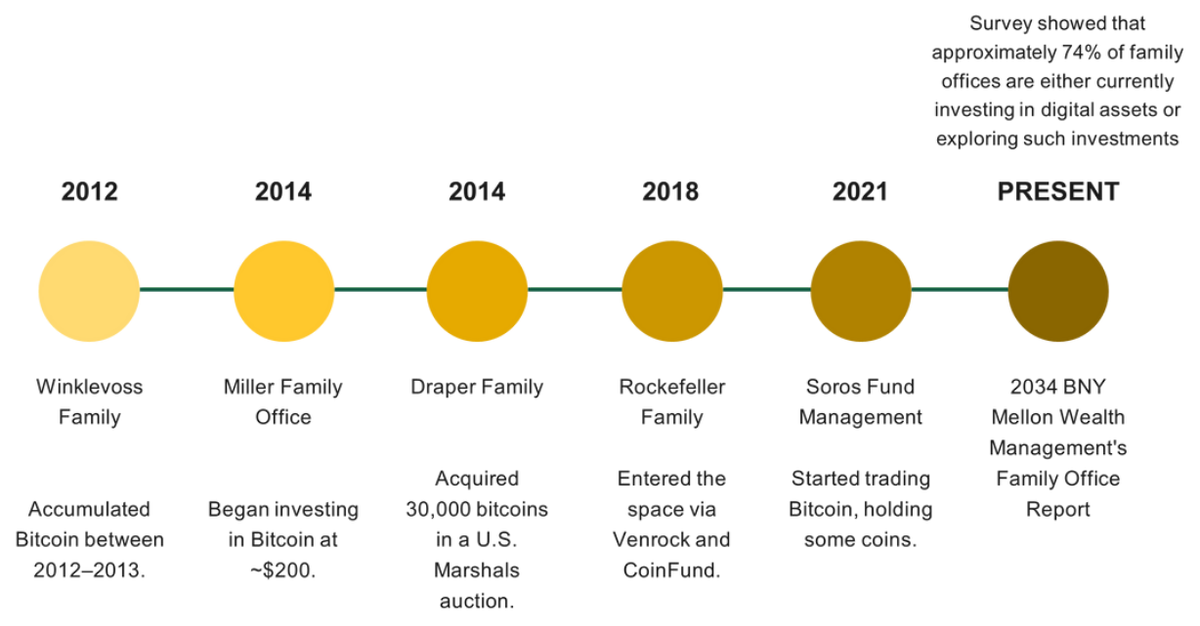
- Miller Family Office (Bill Miller): Accumulated Bitcoin as a hedge against inflation and currency debasement. Miller publicly framed Bitcoin as “digital gold” and positioned it as a long-term, uncorrelated store of value.
- Draper Family (Tim Draper): Integrated Bitcoin as a core holding alongside venture investments, viewing it as a disruptive innovation with asymmetric upside.
- Winklevoss Family Office: Among the earliest large-scale allocators. Combined direct holdings with ecosystem investment through Gemini, underscoring Bitcoin’s dual role as a store of value and infrastructure platform.
- Rockefeller Family Office: Adopted a cautious approach, beginning with blockchain venture capital exposure before allocating directly to Bitcoin at modest portfolio weights (<1%), emphasizing long-term optionality over short-term gains.
- Soros Fund Management: While not a traditional family office, Soros’ team has acted as a bellwether, framing Bitcoin as both a hedge and a potential disruptor of traditional financial systems.
These adopters pursued different strategies, but all recognized Bitcoin’s potential to preserve wealth, diversify portfolios, and align with intergenerational investment priorities.
Strategic Benefits Realized
- Wealth Preservation: Early allocations have materially appreciated, establishing Bitcoin as a long-term store of value.
- Diversification: Low correlation with traditional assets has provided insulation during market stress.
- Intergenerational Alignment: Bitcoin resonates strongly with younger family members, fostering cross-generational engagement in investment strategy.
Common Challenges
- Volatility: Requires disciplined allocation sizing, phased entry, and tolerance for drawdowns.
- Custody & Security: Selecting institutional-grade custody partners and implementing multi-signature structures proved essential.
- Regulation: Global regulatory complexity necessitated proactive legal guidance and jurisdiction-specific compliance.
- Strategic Flexibility: Some adopters benefited from rebalancing policies and dynamic position sizing.
Lessons Learned for Family Offices
- Start Small, Scale Gradually: Initial allocations should be modest, with room to expand as familiarity and conviction grow.
- Prioritize Security: Custody decisions are foundational; robust solutions must precede significant allocations.
- Educate and Engage the Next Generation: Bitcoin can serve as a bridge for involving younger family members in the management of the family’s wealth.
- Maintain Flexibility: Investment policies should account for rebalancing, liquidity needs, and evolving regulation.
Takeaway
Early family office adopters demonstrate that Bitcoin can be successfully integrated into multi-asset portfolios when approached with discipline. Their experiences reinforce the importance of careful sizing, strong operational controls, and an intergenerational mindset, principles that other family offices can adopt to capture Bitcoin’s upside while managing its risks.
Integrating Bitcoin While Upholding Family Values and Legacy
For family offices, investment decisions extend beyond financial returns; they reflect a family’s values, priorities, and long-term vision. Bitcoin, with its decentralized, transparent, and secure design, presents a unique opportunity to align capital with principles such as financial inclusion, human rights, environmental stewardship, and disciplined wealth preservation. With the right framework, family offices can integrate Bitcoin into their portfolios in a way that strengthens both financial resilience and legacy impact.
Promoting Financial Inclusion
Bitcoin enables access to the global financial system for those excluded from traditional banking. In regions affected by restrictive policies or weak financial infrastructure, Bitcoin offers a lifeline for savings, remittances, and cross-border commerce. For family offices with philanthropic objectives, supporting Bitcoin adoption can facilitate low-cost, near-instant remittances and protect vulnerable communities from inflationary erosion.
Preserving Wealth in High-Inflation Economies
In countries facing currency crises, from Venezuela to Turkey, Bitcoin has functioned as a hedge against local currency collapse. Family offices that support adoption empower individuals to protect purchasing power and preserve stability during macroeconomic volatility.
Advancing Human Rights and Privacy
Under authoritarian regimes, financial systems are often weaponized through surveillance, seizures, and restrictions. Bitcoin provides autonomy and privacy, aligning with principles of freedom and human dignity. Allocating to Bitcoin or supporting its ecosystem positions a family office as a champion of financial independence and human rights.
Driving the Energy Transition
Bitcoin mining has evolved to complement renewable energy and grid stability. Miners increasingly act as flexible buyers of last resort, absorbing excess renewable generation and reducing wasted energy. Others repurpose stranded gas, lowering methane emissions. For environmentally focused family offices, this positions Bitcoin as an unexpected but effective tool in advancing sustainability goals.
Establishing a Governance Framework for Responsible Bitcoin Integration
Clear Investment Mandate: Define Bitcoin’s purpose in the portfolio, whether as a hedge, growth asset, or impact investment. Formal mandates on allocation, liquidity, and performance expectations anchor Bitcoin within the family’s broader investment philosophy.
Decision-Making and Intergenerational Engagement: Strong governance structures help balance Bitcoin’s volatility with long-term objectives. Appointing a dedicated Bitcoin Strategy Officer (internal or external) can provide oversight. Involving younger family members builds familiarity with emerging technologies and strengthens continuity across generations.
Institutional-Grade Security and Compliance: Secure custody should be non-negotiable. Multi-institutional, insured, and compliant solutions ensure assets are protected from cyber threats and operational risks. Staying ahead of tax and legal obligations also preserves transparency and integrity.
Ongoing Reviews and Communication: Bitcoin’s role should be reassessed regularly against family objectives and the broader regulatory and market environment. Open communication within the family fosters alignment, addresses concerns, and reinforces shared purpose.
Conclusion
By embedding Bitcoin within a values-driven governance framework, family offices can unlock its dual role: a strategic portfolio asset and a vehicle for meaningful impact. This approach ensures that wealth is preserved, principles are upheld, and legacies are strengthened, positioning families not only to safeguard capital but also to contribute to a more resilient and equitable financial future.
Conclusion: Bitcoin’s Role in the Future of Family Office Investing
As family offices navigate an increasingly complex financial landscape, Bitcoin stands out as a distinct opportunity to achieve two enduring objectives: preserving and driving long-term growth. Its defining attributes (finite supply, decentralization, and independence from traditional financial systems) make Bitcoin more than just another asset class; it is a structural safeguard against monetary erosion and systemic risk.
Strategic Alignment with Family Office Objectives
This report has shown how Bitcoin can strengthen family office mandates in three critical ways:
- Wealth Preservation Across Generations: By acting as a hedge against fiat debasement and inflation, Bitcoin protects purchasing power and safeguards family capital over the long term.
- Portfolio Diversification: With its low correlation to traditional assets, Bitcoin offers resilience during periods of market stress, reducing reliance on equities and bonds.
- Values-Driven Impact: Through its alignment with renewable energy adoption, financial inclusion, and human rights, Bitcoin provides a way for family offices to invest with purpose while reinforcing their broader legacy.
Reinforcing Legacy and Growth
For many families, wealth is not only financial but also cultural and generational. Bitcoin’s digital, borderless nature resonates with younger generations who will inherit stewardship of family assets, creating a natural bridge across age groups. By allocating thoughtfully (supported by robust governance, secure custody, and clear investment mandates), family offices can capture Bitcoin’s growth potential while maintaining control and integrity.
Looking Ahead
Adopting Bitcoin is not without challenges. Volatility, evolving regulations, and custody risks require careful management. Yet, the strategic case is increasingly clear: Bitcoin is emerging as a cornerstone asset for the future of family wealth.
Family offices that adopt a measured, values-aligned approach (starting with a prudent allocation, emphasizing security, and embedding governance) will be best positioned to benefit. In doing so, they not only preserve capital but also ensure their legacy remains relevant, resilient, and impactful in a rapidly digitizing world.
Appendix: Family Office Governance Checklist for Bitcoin Investments
Use this checklist to ensure a robust governance framework for Bitcoin investments within your family office.
1. Define Investment Mandates
- Set clear allocation levels and target outcomes for Bitcoin investments.
- Determine liquidity requirements and align them with family objectives.
2. Establish Decision-Making Structures
- Appoint Bitcoin-specific expertise within the family office team.
- Assign a Bitcoin Strategy Officer or external consultant for strategic guidance.
- Include younger generations in decision-making to foster intergenerational engagement.
3. Ensure Secure Custody
- Choose institutional-grade custody solutions with multi-signature capabilities.
- Opt for multi-jurisdictional setups for added security.
- Verify that custody solutions have SOC 2 compliance and insurance coverage.
4. Maintain Regulatory Compliance
- Consult legal experts to navigate evolving regulations and ensure compliance.
- Ensure proper tax reporting for Bitcoin holdings and transactions.
- Align all investment activities with jurisdictional legal requirements.
5. Conduct Periodic Reviews
- Schedule regular reviews of Bitcoin portfolio performance and risks.
- Evaluate alignment with family’s long-term goals during each review cycle.
- Communicate outcomes and decisions transparently with all family members.
Instructions for Use:
- Review each item and check the corresponding box once completed.
- Revisit this checklist regularly to maintain alignment with evolving strategies and market conditions.
Why Onramp
For family offices evaluating the implementation path, Onramp provides the custody architecture, operational infrastructure, and advisory support designed specifically for multi-generational wealth holders. The platform combines Multi-Institution Custody with dedicated vaults, on-chain verification, institutional governance controls, and reporting that integrates with existing family office operational workflows.
Bitcoin is not a departure from the family office mandate. Thoughtfully implemented, it is a reinforcement of it: an asset that preserves purchasing power across regimes, grows capital through a fixed supply mechanism that cannot be manipulated by any authority, and aligns with the principles of financial sovereignty and generational resilience that define the best family office thinking.