The New Money Stack: The Custody Layer

The Custody Layer
The New Money Stack Series, Vol. II
Bitcoin is a bearer asset. Whoever holds the keys owns the coins. There's no share registrar to call, no transfer agent to fix a mistake, no clearinghouse standing behind the trade. Mismanage the private keys and the bitcoin is gone. Have them compromised and there's no one to reverse the transaction.
This changes what custody actually is. For equities and bonds, custody is record-keeping. For bitcoin, custody is the security model itself.
Most institutional capital flowing into bitcoin today ignores this. The default playbook — pick a reputable name, hand over the assets — has cost the industry $655 billion and 6.55 million BTC. Mt. Gox, FTX, Celsius, Bybit. Different decades, different names, same architecture.
The Custody Layer is a 36-page deep-dive on what fiduciaries are actually choosing when they pick a bitcoin custodian, and why Multi-Institution Custody is the only model built for a digital bearer asset.
What's inside:
Part 1 — The Problem.
Why bitcoin custody is structurally different from traditional custody, and what BlackRock's own SEC filings reveal about the protections clients actually have.
Part 2 — The Four Models.
A plain-language walkthrough of self-custody, collaborative custody, single-custodian custody, and Multi-Institution Custody — framed around one question: how many independent institutions must collude to move your bitcoin?
Part 3 — Under the Hood.
The technical layer: native multisig vs MPC vs HSM. Why on-chain auditability matters. Why the "Quorum of Quorums" structure makes MIC the hardest architecture available.
Part 4 — The Institutional Case.
The actuarial math, the credit rating implications, the ETF concentration problem, insurance and estate planning, and the regulatory framework post-SAB 122 and the GENIUS Act.
The thesis: Single-custodian models work well for equities and bonds, where the asset exists on a recoverable register and custody is a record-keeping function. They are structurally inadequate for a bearer asset where possession is ownership, loss is permanent, and legal protections remain untested.
Multi-Institution Custody is not a marginal improvement. It is a structural category change. In a world where fiduciary capital is flowing into the hardest money ever created, the architecture that protects it should be the hardest architecture available.
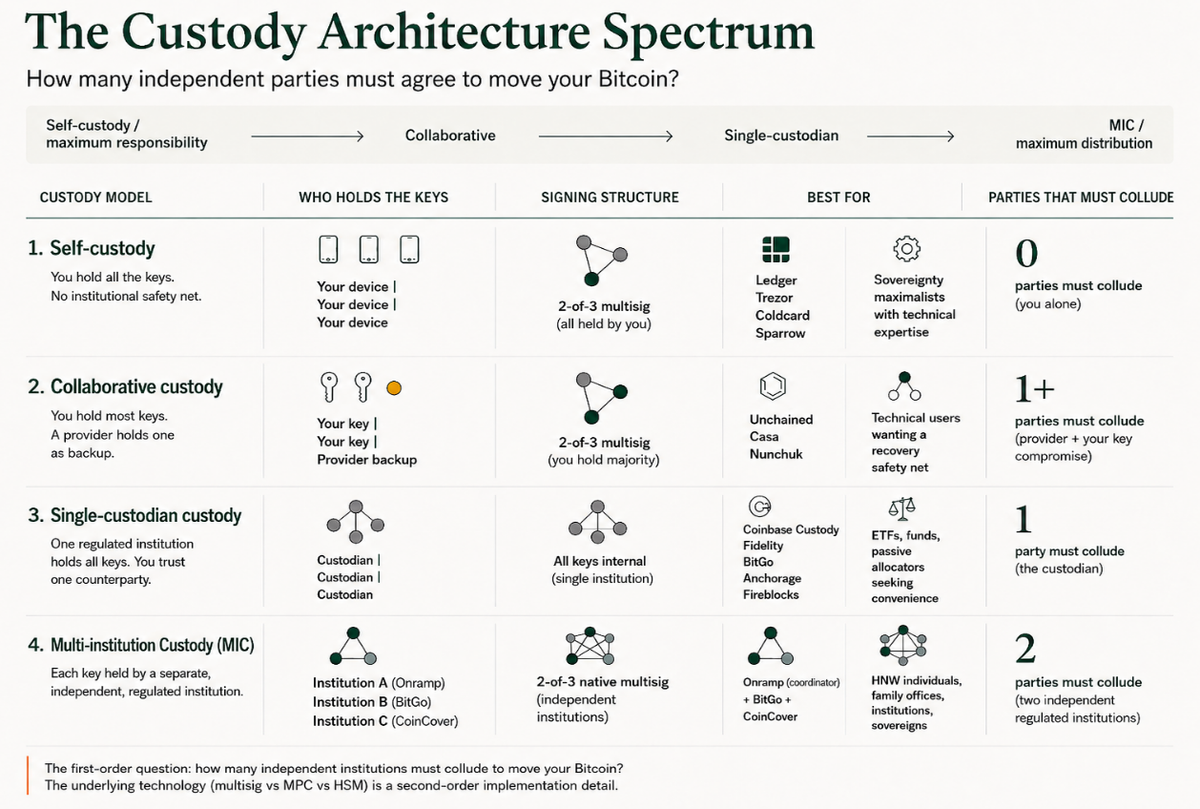
We break down the single page from BlackRock's S-1 that every IBIT allocator should read. Why "BlackRock would cover the loss" doesn't survive a look at the balance sheet. The Coinbase concentration problem hiding inside 8 of 11 spot Bitcoin ETFs. A walk-through of the four custody models in plain language, framed around one question: how many independent institutions would have to fail simultaneously for your bitcoin to be at risk? The actuarial math behind a 1,000x reduction in catastrophic loss probability. How Morningstar DBRS thinks about custody architecture in its credit ratings. The Quorum of Quorums — how MIC distributes trust both across and within institutions. And the regulatory map after SAB 122, the OCC charter wave, and the GENIUS Act.
Written for CIOs, family offices, RIAs, pension trustees, and corporate treasurers who need to understand the choice they're making.