August 4, 2026 Weekly Market Brief
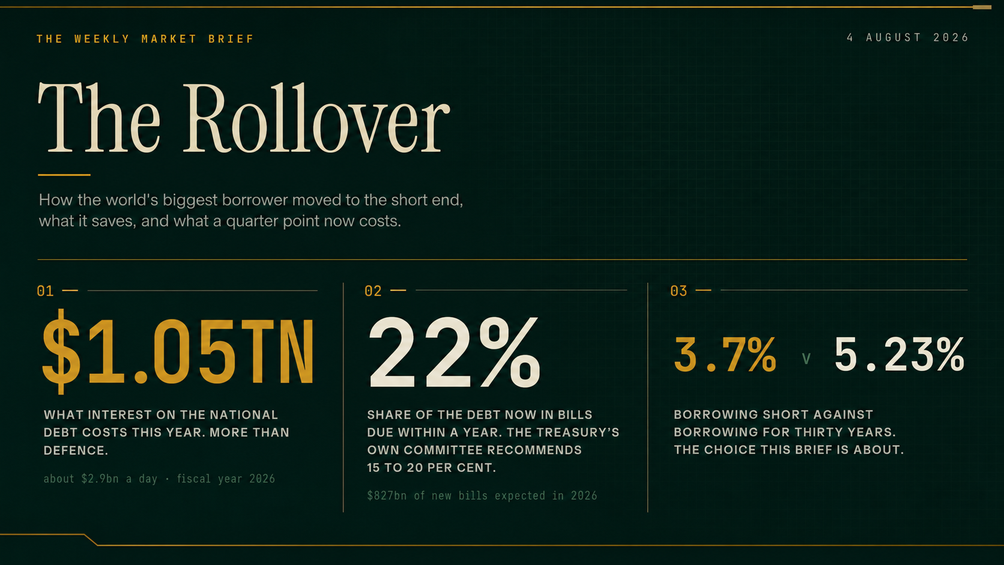
The US Treasury is funding itself with short-term bills at a pace that has pushed them to 22 per cent of the tradeable debt, above the 15 to 20 per cent its own advisory committee recommends. The logic is sound on today's prices: 3.7 per cent for a month against 5.244 per cent for thirty years, the highest since 2007. But it hands the pricing of a growing share of the debt to a Federal Reserve that just voted nine to three to hold, with three members preferring a rise.

Last week the Federal Reserve argued in public about raising interest rates, and the yield on thirty-year US government debt touched its highest level since 2007. This brief is about a decision that connects those two facts. The United States government is doing more of its borrowing in short-term paper than at any point in years, on purpose, and the reasons why, and what it risks, are worth understanding before September.
How the government borrows
The US Treasury borrows by selling three kinds of paper. Bills mature in a year or less, most in a few weeks or months. Notes run from two to ten years. Bonds run to twenty or thirty. The interest rate on each is set at auction, by whatever price buyers will pay, and the auctions never stop. Bills are sold every single week.
The government has borrowed about two trillion dollars of new money over the past twelve months, on top of refinancing the old debt as it matures. And the workhorse of that borrowing has become the very shortest instrument on the list. In 2016, a typical auction of four-week bills raised about 47 billion dollars. In 2026 the average is 101 billion, which makes a bill that expires in one month the single largest security the United States sells.
Every bill has to be repaid or replaced within weeks or months of being sold. So a government that funds itself with bills is a government that returns to the market constantly, and resets the interest rate on that part of its debt almost continuously. Keep that fact in view. Everything below follows from it.
The shift
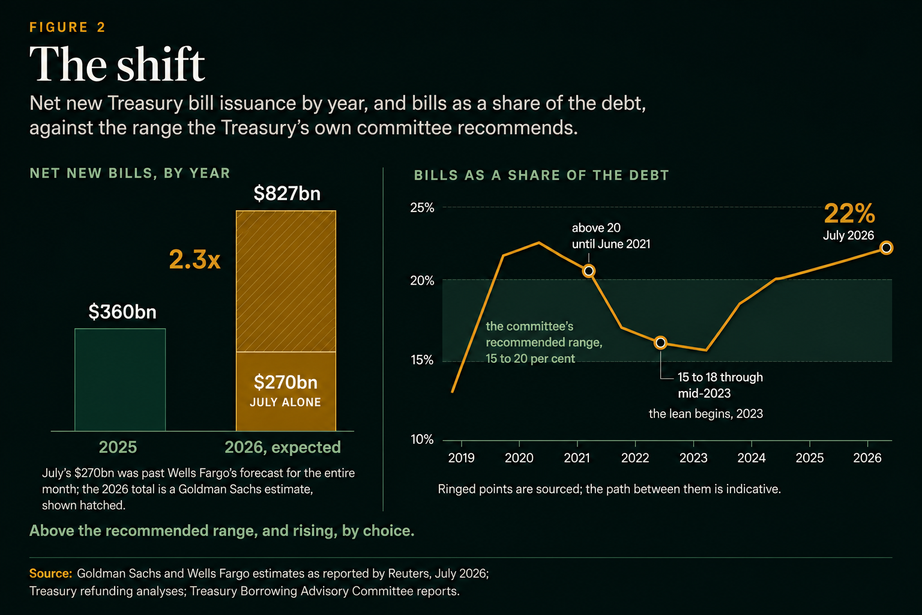
The lean toward short paper has accelerated sharply this year. Goldman Sachs expects total net bill issuance of 827 billion dollars in 2026, more than double the roughly 360 billion of 2025. In July 2026 alone, net bill issuance of about 270 billion dollars had already exceeded what Wells Fargo had forecast for the entire month, and July by itself raised nearly twice as much through bills as the whole first half of the year.
Bills now make up 22 percent of the government's outstanding tradeable debt. The Treasury's own advisory committee of market participants has long recommended keeping that share between 15 and 20 percent. It is above the range, and rising.
The Treasury also publishes its borrowing plans quarterly, and the next of those statements is due in the first week of August 2026, within days of this brief. The lean toward bills is deliberate policy. It began in 2023, when Congress suspended the debt ceiling and the Treasury had to rebuild its cash quickly, and bills were the instrument that could be scaled up fastest. Bessent has continued what began as an emergency tool, holding the auction sizes of longer-term notes and bonds flat while pushing the growth into bills. The Treasury's stated reason is exactly what you would guess: to help contain borrowing costs.
The case for doing it
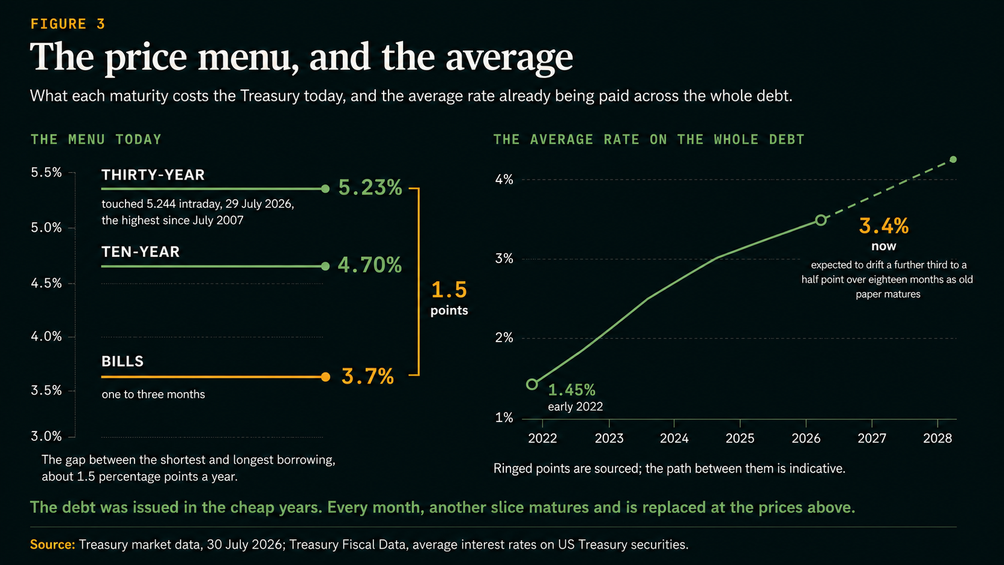
Be fair to the people making this choice, because their logic is not hard to follow. Look at the menu of prices the market is currently offering the Treasury. Borrowing for a month or three months costs about 3.7%. Borrowing for ten years costs 4.70%. Borrowing for thirty years costs 5.244%, its highest since July 2007.
Locking in thirty-year money today means fixing the most expensive long-term rate in nineteen years, and paying it until 2056. Bessent has said as much in public, remarking in 2025 that long-term issuance made little sense with rates so far above their long-run average, and that the time to have done it was 2021 or 2022, when the thirty-year cost less than 2%. He is right about the missed window.
So the short lean is a judgement call with a clear logic: pay 3.7 now rather than commit to 5.244 for three decades, and wait for better long-term rates before locking anything in. It saves real money immediately. On this year's new bills alone, the gap between the short rate and the thirty-year rate is worth roughly twelve billion dollars a year in avoided interest, potentially every year for thirty years. The choice does save money today; what matters is what it depends on.
What interest already costs
Some context on the size of the bill that is being managed. Interest on the national debt is running at roughly 1.05 trillion dollars for fiscal year 2026, which is about 2.9 billion dollars every day, and more than the United States spends on defence. On official projections it passes Medicare around 2027.
And the direction of travel is set by arithmetic rather than opinion. The average interest rate across the government's debt is now about 3.4%, up from roughly 1.5% in early 2022. That average keeps climbing for a simple reason: the debt was mostly issued in the cheap years, and every month another slice of it matures and gets replaced at today's prices. The old rates roll off. The new ones roll on. Hence the title of this brief. The total debt passed 39 trillion dollars this spring, and analysts who track the rollover expect the average rate to drift up by a further third to a half of a percentage point over the next eighteen months, whatever the Fed does, purely because of which old paper comes due.
The counterargument, and its limit
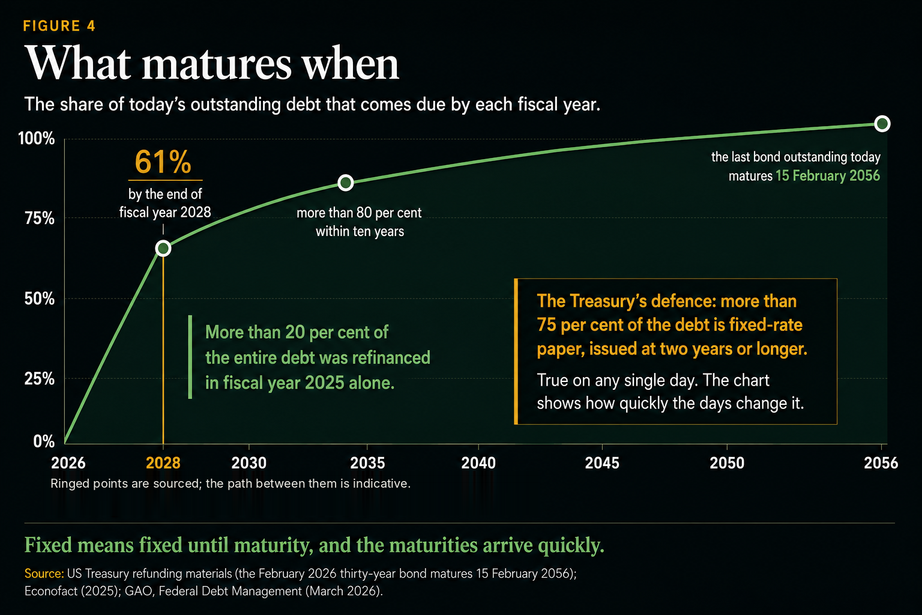
The Treasury has an answer to concerns about the short lean, and it deserves to be quoted properly. A senior official said in July 2026 that since more than 75 percent of the tradeable debt is fixed-rate paper originally issued with a maturity of two years or longer, changes in short-term interest rates do not affect the vast majority of the government's interest costs.
That statement is true, but it describes a photograph at this moment in time. The debt, viewed on any single day, is mostly long-dated and fixed. But a photograph is not the relevant picture for a borrower who must constantly refinance. More than 20 percent of the entire debt was refinanced in fiscal year 2025 alone. By face value, 61 percent of the debt outstanding today matures by the end of fiscal year 2028. A rate is only locked for as long as the paper it is printed on lasts, and the paper is getting shorter. As HSBC's US rates strategist put it in July 2026, if rates need to go up materially, the funding cost will be substantially higher when the debt sits in bills, because so much more of it must be refunded so much more often.
What a quarter point would do
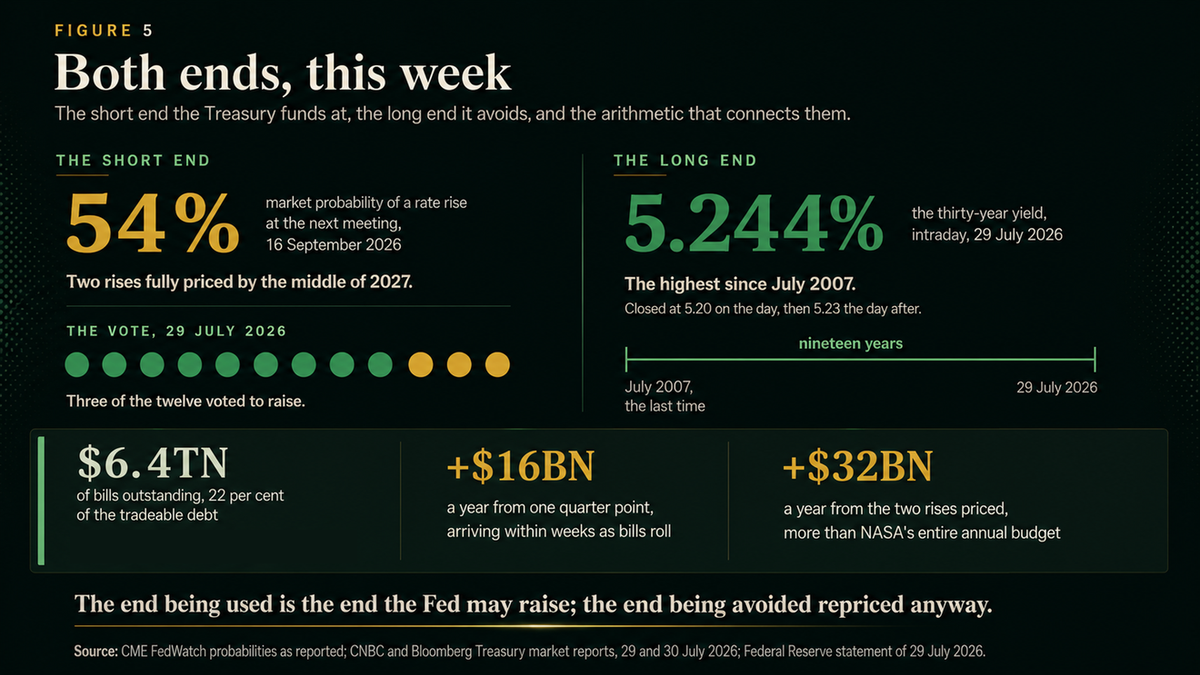
Now connect this to what the Federal Reserve spent the week debating. On Wednesday 29 July 2026 the Fed held its rate at 3.50 to 3.75 percent, but the vote was nine to three, the dissenters preferring an increase. The market now prices a 54 percent chance of an increase at the next meeting on 16 September 2026, and two increases are fully expected by the middle of 2027. The chairman told the press conference the Fed will not hesitate to act, and that higher rates could well be part of the solution.
Bill rates track the Fed's rate almost exactly, and bills roll over in weeks. So when the Fed changes rates, the government's cost on its growing stack of bills moves with it, almost immediately. There are roughly 6.4 trillion dollars of bills outstanding on our arithmetic. A single quarter-point increase adds about 16 billion dollars a year to the interest bill as those bills roll. The two increases the market currently expects would add roughly 32 billion a year. For comparison, that is more than the entire annual budget of NASA, added to the interest line by two committee votes.
Notice what has happened to the relationship between the two institutions. The Treasury has chosen the funding pattern that is most exposed to the Fed's policy rate, at the precise moment the Fed is debating raises. Every step the Fed takes against inflation now flows directly and quickly into the government's own borrowing costs, which widen the deficit, which requires more borrowing. The two policies are pulling against each other, and the point where they meet is the weekly bill auction.
Who buys the bills
One thing is not in doubt: the buyers are there. Money market funds hold trillions and exist to buy this paper; foreign institutions and banks buy it too. Even the new digital-dollar companies have become large customers. Tether, the issuer of the biggest dollar stablecoin, holds about 141 billion dollars of US Treasuries, mostly bills, which by its own account makes it the seventeenth largest holder in the world, ahead of most countries.
Bills are easy to sell because they are the closest thing to cash that pays interest, and enormous pools of money are required by their own rules to hold exactly that. Demand at the short end is deep, which is precisely why the Treasury can lean on it. The strain shows up somewhere else: at the long end, where this week's 5.244% is the market's price for lending to America for thirty years. The Treasury has been sparing that market by not asking much of it. It repriced to a nineteen-year high anyway, which tells you the avoidance is being noticed, and priced.
The position, stated plainly
Put the pieces together and the government's position is this. It cannot comfortably borrow long, because long rates are the highest since 2007 and locking them in would fix that cost until the 2050s. So it borrows short, where money is cheapest. But borrowing short hands the pricing of its debt, more and more of it, to a Federal Reserve that is publicly split toward raising rates. If the Fed hikes, the cost arrives within weeks. If the Treasury flees back to the long end instead, it must lock in the very rates it has spent two years avoiding, into a market already charging rates at nineteen-year highs.
Every path from here is a form of paying more. The only question is when, and on which end of the curve. This is not a crisis, and we are not describing one. Auctions clear and buyers show up. It is a squeeze, tightening slowly from both ends, and it is being managed week to week, one bill auction at a time.
What we are watching
This week's refunding statement.
Each quarter the Treasury publishes its borrowing plans, with the next statement expected the first week of August 2026. Watch one thing: whether the coupon auction sizes finally rise, which would mean the Treasury has started paying up for time, or whether the growth stays in bills, which would mean the position described above gets larger.
16 September 2026.
The next Fed decision, with an increase priced as slightly more likely than not. If it comes, the effect on the government's bill costs begins arriving before October.
The 22 percent.
The bill share of the debt against the advisory committee's 15 to 20 percent recommendation. How far above the range it is allowed to drift is the number to watch through the autumn.
The average rate.
The Treasury publishes the average interest rate on the debt monthly, next in early August 2026. It has climbed from about 1.5 percent to about 3.4 since 2022. Each month's figure tells you how much of the cheap old debt has now rolled away.
The long auctions.
The Treasury still sells ten and thirty-year paper every month, in deliberately unchanged size. The prices those small auctions fetch, with the thirty-year near 5.25%, are the running quote on what escaping the short end would cost.
The through line
Readers of our weekly brief entitled "Their Own Best Customer" (28 July 2026) saw how companies choose which year and which line a cost appears in. Governments have the same choice, and maturity is how they make it. Borrowing short books the smallest interest cost available today and accepts the largest sensitivity to changes in rates tomorrow. Nothing about it is inherently improper. It is simply a position, the kind a trader would recognise instantly: funded overnight, exposed to the next rate decision, profitable if rates fall, and expensive if the committee that sets rates keeps talking the way it talked last week.
The observation this weekly brief series keeps arriving at, from different directions, is this. Everything the government borrows sits on a calendar. Two trillion dollars a year of new money, an auction every week, a refunding statement every quarter, a rate decision every six weeks, and a growing share of the debt that must be repriced before Christmas.
Set against that stands a monetary system with no debt, one that spent the week with nothing maturing, nothing to refinance and no auction to clear, issuing about 450 new coins a day on a schedule set in 2009, at a price roughly half its October 2025 high. Bitcoin has many properties. This week's relevant one: it is a monetary system with no rollover risk, because it does not borrow.
SOURCES: US Treasury quarterly refunding materials and auction data; Treasury Borrowing Advisory Committee reports; Peter G. Peterson Foundation analysis of the February 2026 refunding (July 2026); Goldman Sachs and Wells Fargo bill-issuance estimates and Treasury official comments as reported by Reuters (July 2026); Treasury Fiscal Data, average interest rates on US Treasury securities; interest-cost and debt figures as compiled from Treasury Fiscal Data and CBO projections; Econofact, The Cost of Financing US Government Debt (2025); GAO report on federal debt management (March 2026); Secretary Bessent remarks as reported (June 2025); Federal Reserve statement and press conference of 29 July 2026 as reported by CNBC; CME FedWatch probabilities as reported; CNBC and Bloomberg Treasury market reports (29 and 30 July 2026); Tether Q1 2026 attestation (BDO). All arithmetic recomputed from source; the bill-stock and quarter-point figures are our own calculations from the stated shares against Treasury Fiscal Data.
The Radar
What matters this week across digital assets, AI, and global markets.
Digital Assets & Regulation
Selling coins to pay the coupon
Strategy's quarter landed as pre-announced: an $8.2 billion net loss, nearly all the markdown on its bitcoin, $24.45 lost per share against $32.60 earned a year ago. Then Monday: 1,638 coins sold at $63,957, about 15 percent below cost, funding preferred dividends and an $81.2 million buyback of its 12 percent STRC paper below par, plus $290.6 million of new common. Holdings 842,138; reserve $4.0 billion. Retiring expensive paper cheaply is defensible arithmetic; a machine built to turn shares into coins now runs the other way.
The window closes Friday
The Clarity Act's pre-recess window is now measured in hours. Monday's Senate schedule carried no vote; a cloture filing by Wednesday is the last route to a Friday motion to proceed, and sixty votes means seven Democrats, with Murphy, Van Hollen and Merkley opposed. Floor time is going to nominations, a stopgap funding bill and the sanctions package instead. Prediction markets have drifted to roughly 30 percent, from 34.5 a week ago. Miss Friday and the next window opens September 14, seven weeks before the midterms.
Fork week arrives
This weekend bitcoin enters a contested activation window. BIP-110, which would limit non-financial data in transactions, hits mandatory signaling near block 961,632 with miner support near 3 percent against a 55 percent bar; nodes enforcing it would reject the majority's blocks, so a small breakaway chain is likelier than a network change. A separate hard fork, eCash, splits off later this month. The two million coins in funds and treasuries will sit out both; the real work, replay protection and credited balances, falls to custodians.
AI & Financial Infrastructure
The market grades the buildout
Five megacaps reported inside nine days, all growing double digits, and the market split them on a single test: proof of demand. Microsoft rose about 9 percent on Azure up 43 percent, a $678 billion backlog and the line that demand exceeds supply; Amazon added 10 percent on the first $200 billion quarter on record. Meta fell about 10 percent after lifting its capex plan toward $145 billion while free cash flow thinned to $784 million. The buildout keeps its money; the market now pays for proof, not promise.
Seoul takes the whiplash
The AI trade's violence now lives in memory chips. Seoul's Kospi fell 17 percent in three sessions, tripping the first back-to-back halts on record as leveraged single-stock funds, launched only in May, unwound; a Chinese memory maker's 466 percent debut fed the fear. Then Friday: up 17.9 percent, the largest day in the index's history, on record Samsung and SK Hynix results and Microsoft's demand line. The index sits some 40 percent below its June peak. Conviction this violent cuts both ways.
Europe's rules get teeth
The EU AI Act's grace period ended Saturday. From August 2 the Commission can supervise and fine the makers of the most capable models, chatbots must disclose that they are machines, and AI-generated content must carry machine-readable marks, with penalties up to 3 percent of worldwide turnover. Around 190 organizations signed the content-marking code, the major labs among them, though OpenAI's compliance statement skipped the training-data chapter. Industry calls the plumbing immature; Brussels, as with data privacy, is again writing the default global rulebook.
Geopolitics & Markets
Nine votes to three
The Fed held at 3.50 to 3.75 percent for a fifth meeting, but the vote was 9 to 3, with the presidents of Dallas, Minneapolis and Cleveland each demanding a quarter-point hike, the first unified triple dissent since September 2016. Chair Warsh said the committee has no soft inflation target; the statement blamed supply shocks, energy among them. Markets now lean toward a September 16 hike, and the 30-year Treasury touched 5.24 percent, its highest since 2007. The long end has been voting for a while.
Quiet, but not peace
The Gulf pause is holding; nothing under it is agreed. Trump says strikes were called off at the request of Riyadh, Abu Dhabi, Doha and Tehran, with a Hormuz deal to precede a nuclear one; Iran denies negotiating with Washington at all and talks only to Oman about the strait. Hormuz passes fewer than 10 ships a day against roughly 100 prewar, and the Houthis' Red Sea blockade has Saudi tankers rounding Africa. He calls Tehran duplicitous; Tehran says Washington broke every commitment in June.
The wars become one
Zelensky spent Tuesday in Washington: a White House meeting, Graham's funeral, then the Senate chamber to watch the vote, 86 to 12, advancing the sanctions act bearing Graham's name. The bill covers Russia and Iran in one instrument and authorizes punitive tariffs on the five largest buyers of Russian oil and gas, China and India named. The battlefield is merging too: Ukraine has struck Iranian shipping in the Caspian and the supply lines between Russia and Iran. One system now.
The Week in Numbers
| Indicator | Reading |
|---|---|
| Where bitcoin trades against its October 2025 high | -49% |
| Coins Strategy sold last week, 15% below cost | 1,638 |
| Miner signaling for BIP-110, against a 55% bar | 3% |
| The Senate's return; Clarity's next real window | Sep 14 |
| Meta's free cash flow in the quarter it raised capex | $784M |
| The Kospi's Friday, its largest one-day gain ever | +17.9% |
| Daily ships through Hormuz, versus about 100 prewar | <10 |
| Senate vote advancing Russia and Iran sanctions | 86-12 |
What to Watch This Week
| Date | Why it matters |
|---|---|
| This week | Circle, Galaxy, Block and six bitcoin miners report, the sector's first full earnings sweep of the bear market. |
| Aug 4 | AMD reports after the close, the first chip-side reading on the demand the megacaps just promised. |
| Aug 7 | July jobs report lands; the Senate's last scheduled day before a recess that runs to September 14. |
| Aug 8-9 | BIP-110's mandatory signaling window opens near block 961,632; with support near 3 percent, enforcing nodes risk splitting onto a side chain. |
| Aug 12 | US July inflation report, the first of two CPI prints before the Fed's September 16 decision. |